
Michigan Marriage Records
Michigan marriage records are public documents held by the county clerk in each of the state's 83 counties and by the Michigan Department of Health and Human Services. Whether you need a certified copy of a marriage certificate, want to search a marriage license database, or are researching family history, there are clear steps to follow. This guide covers how to find and request Michigan marriage records at both the state and county level.
Michigan Marriage Records Overview
Where Michigan Marriage Records Are Kept
Michigan uses a dual system for marriage records. The county clerk in each of the 83 counties issues marriage licenses and keeps the official record of marriages performed there. The state office, the Michigan Department of Health and Human Services (MDHHS), also maintains certified copies of marriage records from 1867 to present. You can request from either the county or the state, depending on which is more convenient.
The MDHHS vital records office handles statewide requests at 333 S. Grand Avenue, Lansing, MI 48933. You can also mail requests to Vital Records Requests, P.O. Box 30721, Lansing, MI 48909. Their phone number is 517-335-8666. Office hours are Monday through Friday, 8:00 a.m. to 5:00 p.m. For most people, going directly to the county where the marriage took place is faster and cheaper.
Some counties hold records that go back well before the state's 1867 requirement. Barry County records date to 1839, Branch County to 1829, and Kalamazoo County to 1831. Marquette County has marriage records from 1850. For older genealogy research, the county clerk's office or a local historical society is often the best starting point.
Under MCL 333.2885, any Michigan marriage record 75 years old or older is a public record. More recent marriage records are also generally available to anyone who requests them. Michigan does not restrict access to marriage records the way it restricts some other vital records.
How to Get a Certified Copy of a Michigan Marriage Record
You can order a certified copy three ways: online, by mail, or in person. Each method works for both state and county requests.
Online orders through the state go through VitalChek. The cost is $34 for the first certified copy plus processing fees. VitalChek accepts credit cards and is generally faster than standard mail requests. The VitalChek Michigan marriage records page is the official online portal authorized by MDHHS for this purpose.
After using VitalChek, most online orders for Michigan marriage records are delivered by mail within the standard processing window of 2 to 4 weeks. If you need your copy faster, you can add rush processing for an extra $12 fee, which cuts the time down to 2 to 3 business days. Rush mail requests should be addressed to Vital Records RUSH, P.O. Box 30721, Lansing, MI 48909. Payment must be by check or money order payable to "State of Michigan." Personal checks are generally accepted at the state office but not at all county offices, so call ahead if you plan to pay by check at the county level.
In-person requests go to the South Grand Building, first floor, 333 S. Grand Avenue, Lansing. You can also visit the county clerk where the marriage took place. County offices often provide same-day service for in-person requests. MDHHS does not require a notarized statement for marriage record requests, though you must show a valid photo ID such as a driver's license, state ID, or passport.
Note: Additional certified copies of the same record ordered at the same time cost $16 each through the state office; most counties charge $5 each for additional copies.
Online Search Tools for Michigan Marriage Records
Several free online tools let you search Michigan marriage records before submitting a formal request. These are useful for genealogy research and for finding which county holds a specific record.
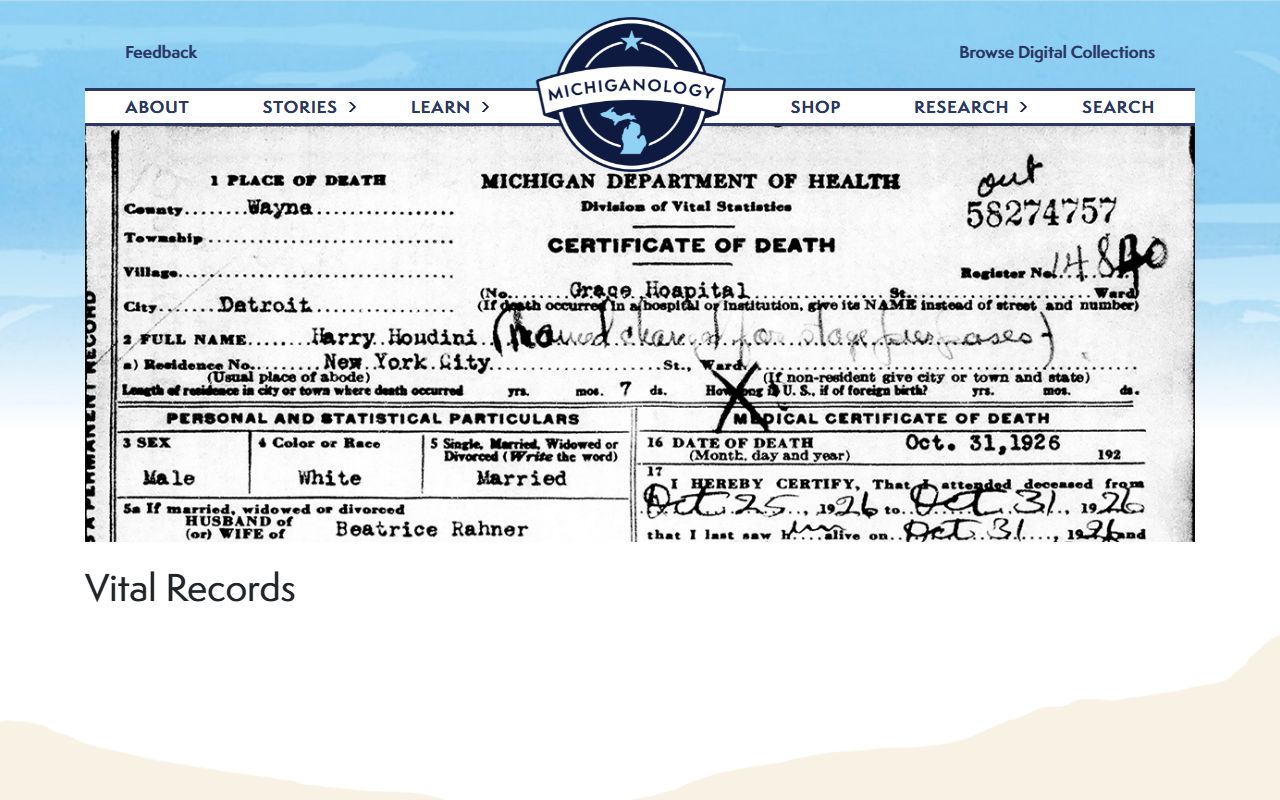
Michiganology is the state's digital archive and holds historical vital records including marriage indexes going back to the early 1800s. The Michiganology vital records page allows searches by name and date range for older collections.
FamilySearch offers free access to several Michigan marriage indexes including the Michigan Marriages 1822-1995 collection, the Michigan County Marriages 1820-1940 collection, and the Michigan Marriages 1868-1925 collection. These are searchable at the FamilySearch Michigan vital records wiki page. Some collections are index-only, meaning you get the reference and then request the actual document from the county. Ancestry.com also holds Michigan marriage records from 1867 through 1952.
Major counties have their own online portals. Oakland County runs a genealogy search at courts.oakgov.com that covers records back to 1868. Genesee County has an online marriage and death search portal through the county website. Kent County offers an online vital records ordering system. Check the individual county page on this site for the specific search portal available in that county.
The Vital Records Online Michigan page provides another search and ordering option for current Michigan marriage certificates.
Note: Online search tools usually show basic record info only; you need a certified copy through the county clerk or MDHHS for any legally valid document.
Michigan Marriage License Requirements
You must obtain a marriage license before a ceremony can be performed in Michigan. Under MCL 551.101, you apply at the county clerk's office in the county where either party lives. If both parties are non-residents of Michigan, apply at the county where the marriage will take place.
Both parties must be 18 years of age or older. You need a valid photo ID and, in most counties, a certified birth certificate. Social Security numbers are required but do not appear on the issued license. They are collected for child support enforcement under Title IV-D of the Social Security Act. The application is an affidavit signed under oath. Providing false information is perjury under Michigan law.
Under MCL 551.103, a mandatory 3-day waiting period applies after you apply. You cannot pick up the license until 3 days have passed, not counting the day you applied. Some counties offer a waiver of this waiting period for an additional fee ranging from $5 to $100 depending on the county. Once issued, a Michigan marriage license is valid for 33 days. If you do not use it within that window, the license expires and you must reapply.
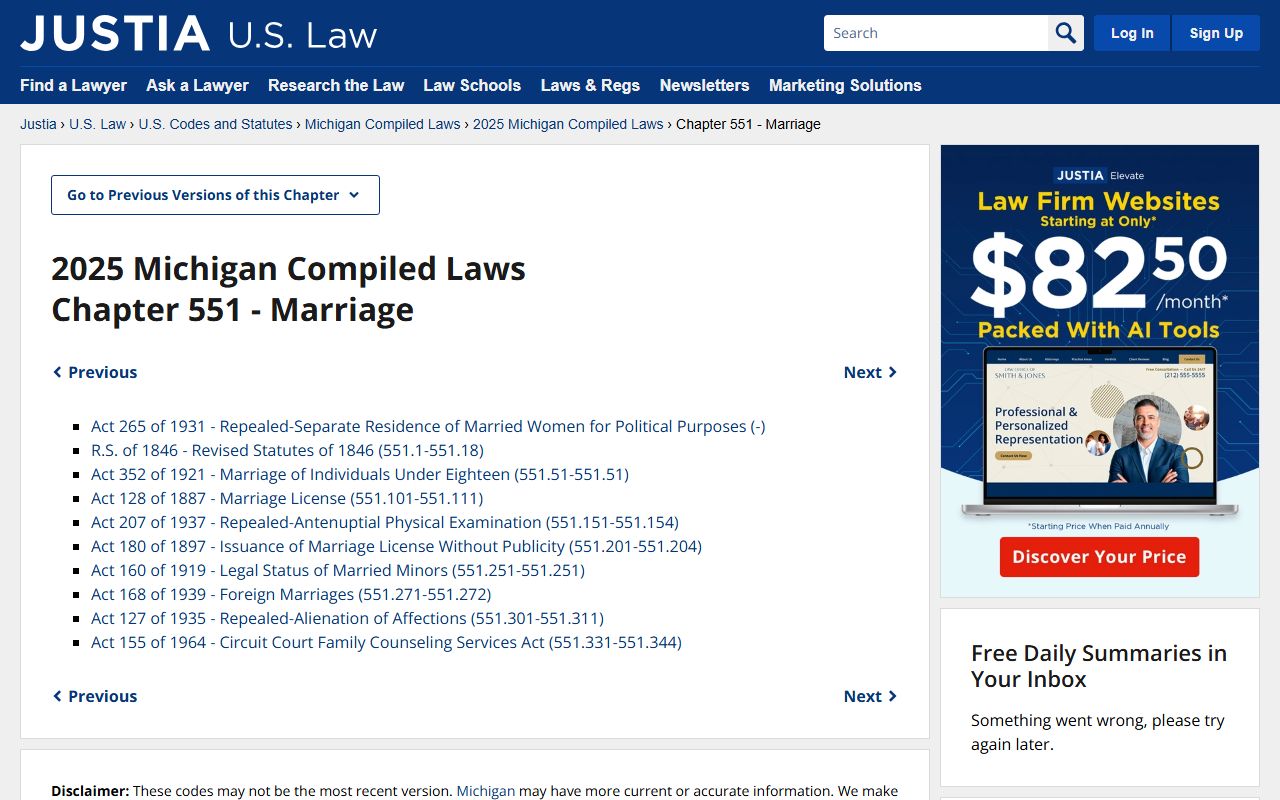
The Michigan MCL Chapter 551 marriage law page on Justia shows the full text of all statutes governing marriage licenses and certificates in Michigan.
The officiant who performs the ceremony must complete the marriage certificate and return the original to the county clerk within 10 days, per MCL 551.104. Failing to return it on time is a misdemeanor under MCL 551.107, punishable by a fine up to $100 or up to 90 days in jail. The county clerk then forwards a copy to the state. Once recorded, the marriage becomes an official Michigan vital record.
What Is on a Michigan Marriage Record
Michigan marriage records contain detailed information about both parties and the ceremony. The application and the completed certificate each hold different data.
The marriage license application is an affidavit that collects personal data before the wedding. It includes the full name, date of birth, birthplace, current address, Social Security number, and number of previous marriages for each party. It also asks for the full names and birthplaces of each party's parents. Some counties ask for email addresses and phone numbers as well. After the ceremony, the officiant adds the date, city or town, county, and state of the marriage, the names of two witnesses, and the officiant's own name and title.
Applications are not public records. Only the applicants can access the application itself. The recorded marriage certificate, however, is a public record that anyone can request. It shows both spouses' names as they will appear after the wedding, the date and location of the marriage, the officiant's credentials, the license number, and the date the county clerk filed the record.
Fees for Michigan Marriage Records
Fees vary by county and by whether you need a certified or plain copy.
The MDHHS charges $34 for the first certified copy and $16 for each additional copy of the same record ordered at the same time. Rush processing adds $12 and delivers in 2 to 3 business days. Payment to the state must be by check or money order payable to "State of Michigan." Online orders through VitalChek carry non-refundable processing and convenience fees on top of the base cost.
County fees are often lower. Many counties charge $15 for the first certified copy and $5 for each additional copy. Wayne County charges $24 for the first copy and $7 for each additional copy. Kent County charges $10 for the first copy and $3 for each additional. An uncertified marriage license search at Wayne County costs $11.50 regardless of whether the record is found. Always call the county clerk to confirm fees before sending payment, as they can change.
For a new marriage license application, Michigan residents pay $20 in most counties and $30 if they are out-of-state residents. Wayne County charges $30 for county residents and $40 for non-residents. Macomb County charges $20 for residents and $30 for non-residents. Ingham County charges $20 for residents and $30 for out-of-state applicants. Wayne County does not accept personal checks; use cash, money order, or a debit or credit card there.
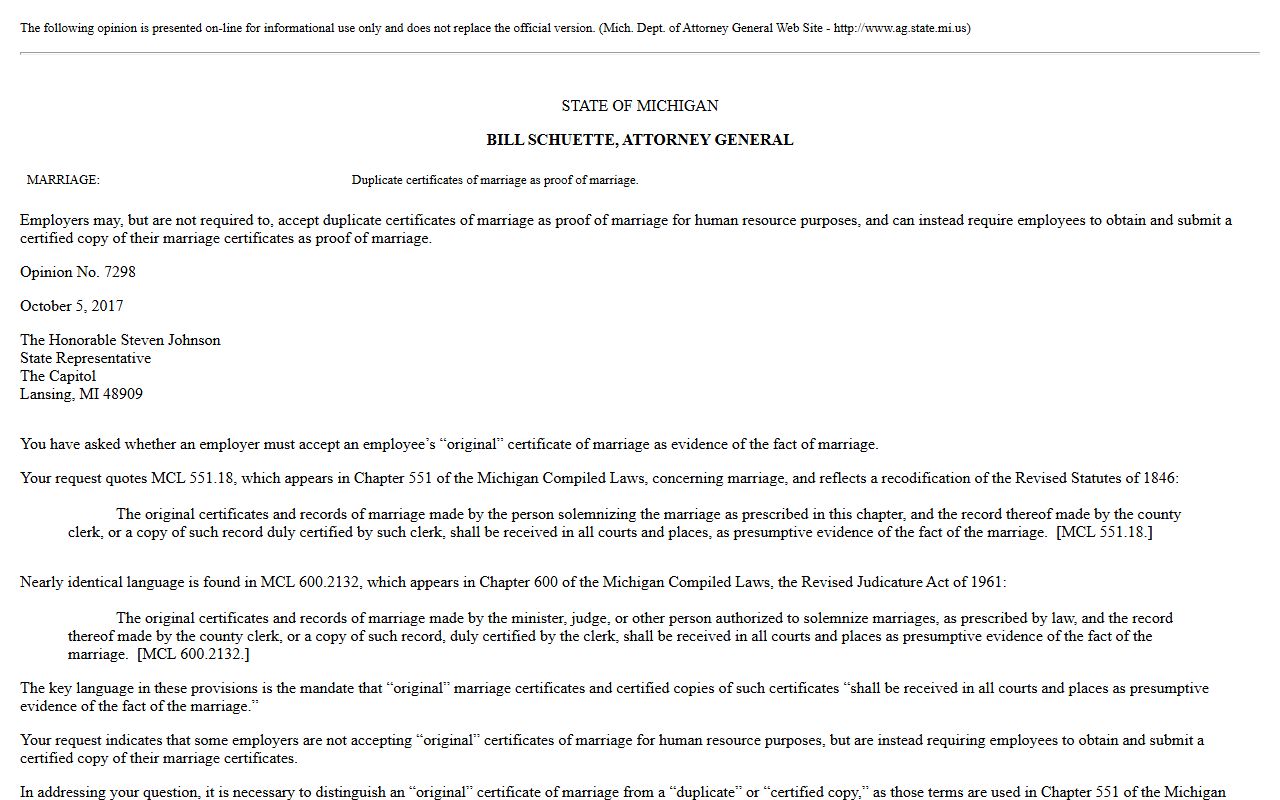
The Michigan Attorney General Opinion 7298 from 2017 clarifies the evidentiary standard for Michigan marriage certificates, confirming that certified copies carry prima facie weight in court under MCL 551.18.
Michigan Marriage Laws and Statutes
Michigan marriage law is found in MCL Chapter 551. The rules governing how licenses are issued, how ceremonies are recorded, and how records can be corrected all come from this chapter. The basic framework has been in place since Public Act 128 of 1887 required marriage licenses statewide.
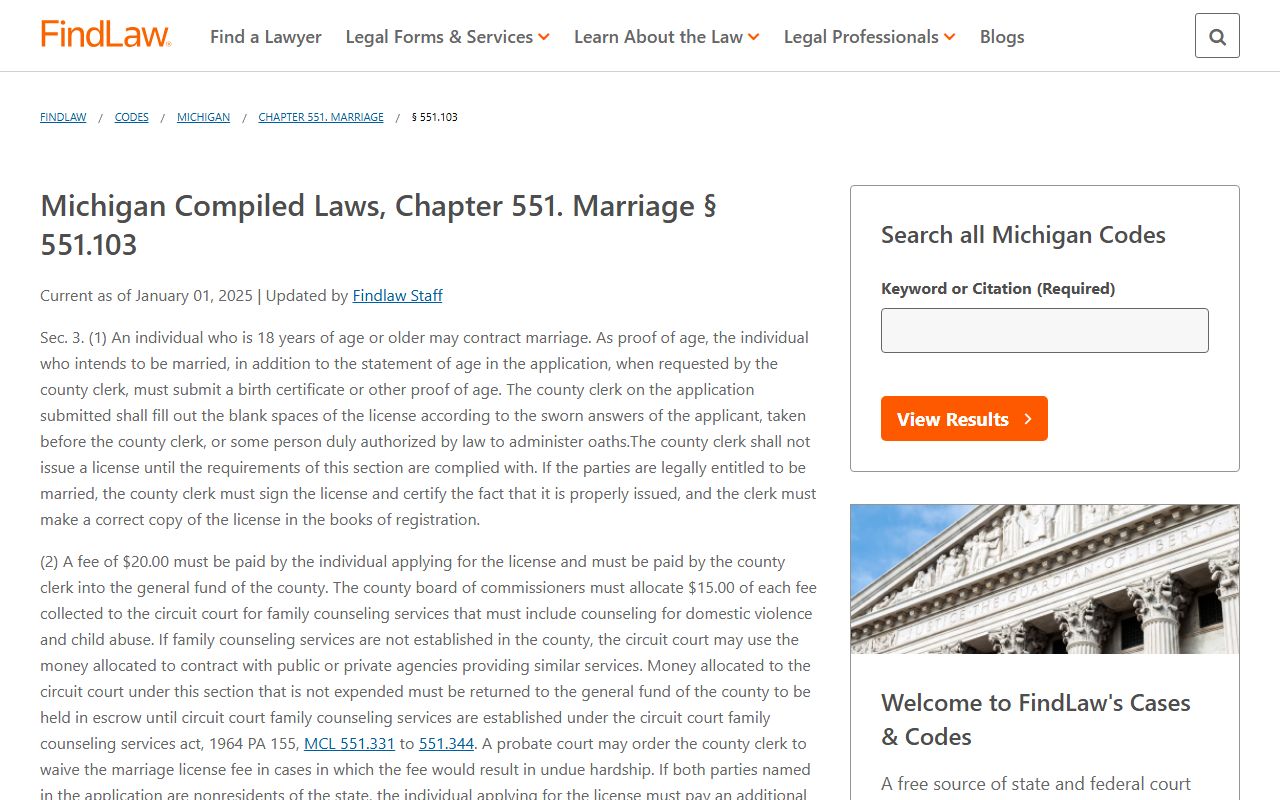
Under MCL 551.110, a marriage certificate is prima facie evidence of the fact of marriage in any court in Michigan. The MCL 551.103 page on FindLaw sets out the 3-day waiting period and the 33-day validity window. MCL 551.111 requires a court order to correct errors on a filed marriage license. That process involves submitting an affidavit to the county clerk, who forwards it to a circuit court judge. The correction fee at many counties is $100, and the process takes about 30 days.
MCL 333.2886 states that certified copies of vital records are prima facie evidence of the facts in the original record. This matters when you use a marriage certificate for name changes, insurance claims, or court cases. MCL 333.2891(3) allows the state registrar to verify identity before releasing a copy of a Michigan vital record, and MCL 333.2894 creates penalties for anyone who makes a false application to change a vital record.
Michigan does not recognize common law marriages formed in Michigan after 1957. The state does recognize common law marriages formed before that date in Michigan or in other states that allow them. Under MCL 333.2885, marriage records 75 years old or older are public records open to anyone. Younger records are also publicly available in Michigan, which has more open access policies for marriage records than for some other vital record types.
Historical Records and Genealogy Research
Michigan has detailed historical marriage records going back to the early 1800s in many counties. Statewide registration started in 1867 when counties were first required to send copies to the state registrar. Before that, local clerks kept the only records. Many of those early records have survived and are now accessible through archives and genealogy databases.
FamilySearch has several collections including Michigan Marriages 1822-1995, Michigan County Marriages 1820-1940, and Michigan Marriages 1868-1925. Ancestry.com holds the Michigan, U.S., Marriage Records, 1867-1952 collection. The Michiganology site has various marriage indexes. SeekingMichigan at seekingmichigan.org also holds digitized genealogical materials tied to Michigan vital records.
When searching old Michigan marriage records, name spellings were not always consistent. Clerks often wrote names the way they sounded. Searching by county and approximate date range can help when an exact name search comes up empty. Some records from smaller counties were also lost over the years due to poor storage or fires.
Browse Michigan Marriage Records by County
Each of Michigan's 83 counties has its own clerk's office that issues marriage licenses and maintains marriage records for that county. Pick a county below to find local contact info, fees, and search resources.
Michigan Marriage Records by City
City residents apply for marriage licenses and request marriage records through the county clerk's office for their county. Pick a city below to find specific guidance and office locations for that area.